This is general health information checked against veterinary sources. It isn't a diagnosis or a substitute for advice from a veterinarian who knows your cat. If your cat may be ill or poisoned, call your vet or the ASPCA Animal Poison Control Center at (888) 426-4435 (a fee may apply).
The Maine Coon is one of the largest domestic cat breeds and one of the few that developed in the United States. Families love its sociable, steady nature, and its size and shaggy coat make it hard to miss. Before you fall for one, it helps to understand what the breed needs day to day and which inherited health problems responsible breeders screen for.
Maine Coon quick facts
| Trait | What to expect |
|---|---|
| Origin | New England, United States; documented history back to the 1850s; CFA championship status in 1976 (CFA) |
| Weight | Mature males can reach or exceed 20 lbs; females are usually smaller (CFA). VCA lists 8–20 lbs (VCA) |
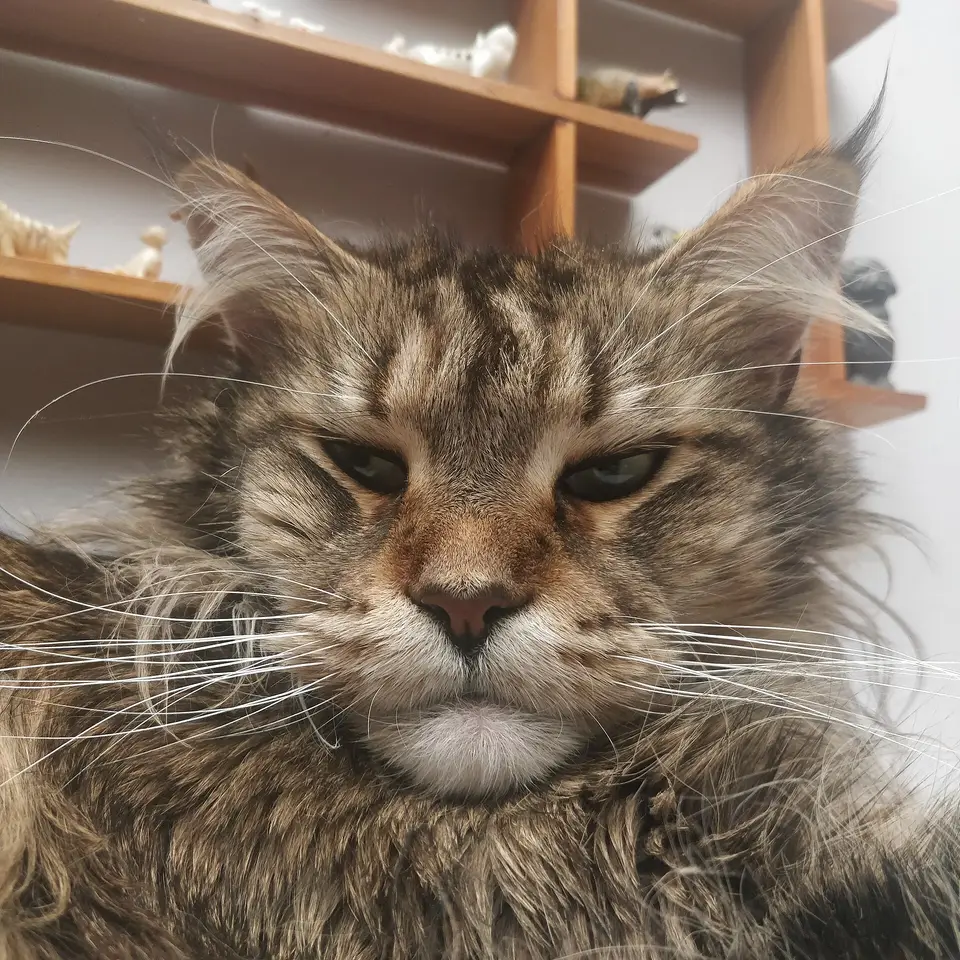
| Coat | Heavy, shaggy and silky; shorter at the shoulders, longer on the sides, belly and back legs (CFA) |
| Lifespan | VCA lists 12–15 years (VCA); one UK veterinary-records study found a median age at death of 11.0 years, from only 14 cats (O'Neill et al.) |
| Activity level | Moderate: gentle and easygoing, yet active (CFA) |
| Grooming | Comb two or three times a week, about 5–10 minutes per session (CFA) |
| Maturity | Slow to mature; can take up to three years to reach full size (CFA) |
Lifespan figures for individual breeds are rough. Registry pages don't publish them, and the published veterinary studies include small numbers of Maine Coons, so treat any single number as a guide rather than a promise.
Temperament
The Cat Fanciers' Association describes Maine Coons as sociable, loyal and intelligent, friendly with children and other animals, and not especially talkative. They tend to be fairly independent and want a moderate amount of human interaction rather than constant attention. VCA Animal Hospitals calls them mellow and affectionate with people, cats and dogs.
Those are breed tendencies, not guarantees. Early handling, health and the household itself shape every cat. If temperament matters most to you, an adult Maine Coon whose personality is already known can be a safer bet than a kitten.
Care needs
Grooming. That long coat sheds and can mat, especially on the belly and back legs. A steel comb used a few times a week keeps it manageable. Most Maine Coons don't need regular baths, according to CFA.
Space and equipment. A cat that may top 20 pounds needs a sturdy, tall scratching post that won't tip, a cat tree rated for its weight and a large carrier. Litter boxes matter too: veterinary guidelines recommend a box about one and a half times the cat's length, and many standard boxes are too small for a full-grown Maine Coon. Our guide to choosing cat litter and a litter box covers sizing.
Play and enrichment. Maine Coons are active without being frantic. Daily interactive play, puzzle feeders and perches suit them well; see our indoor cat enrichment ideas.
Extra toes. Some Maine Coons are polydactyl, meaning they have extra toes. VCA notes this congenital trait causes no adverse health concerns, though those claws still need regular trimming.
Known health concerns and genetic tests
Maine Coons are generally sturdy, but three inherited conditions are well documented in the breed. Breeders who take health seriously test for all three, and CFA's breed profile notes that breeders screen for hip dysplasia by x-ray and for HCM by DNA test and echocardiogram.
| Condition | What it is | How breeders screen |
|---|---|---|
| Hypertrophic cardiomyopathy (HCM) | Thickening of the heart muscle | DNA test for the MYBPC3 A31P variant, plus echocardiograms |
| Hip dysplasia | Abnormal hip joint development | Hip x-rays graded by a registry |
| Spinal muscular atrophy (SMA) | Inherited condition causing muscle wasting | DNA test for the known gene deletion |
Hypertrophic cardiomyopathy (HCM)
Cornell Feline Health Center calls HCM the most common heart disease of cats and lists the Maine Coon among predisposed breeds. Many affected cats look healthy; others develop breathing trouble, lethargy or blood clots that can suddenly paralyze the hind legs.
A variant in the MYBPC3 gene, called A31P, is linked to HCM in Maine Coons. In a 2013 multi-center study, cats with two copies of the variant had far higher odds of HCM than cats with none, and every homozygous cat older than three years was affected. Cats with one copy had a much lower risk. The same study found Maine Coons with HCM that did not carry A31P at all, which means other causes exist.
That is why the ACVIM consensus guidelines, written by veterinary cardiologists, recommend genetic testing for Maine Coons intended for breeding, advise against breeding cats with two copies, and suggest regular echocardiogram screening even for cats that test negative.
Vet check: Fast or labored breathing at rest, open-mouth breathing, or sudden pain or weakness in the back legs can signal heart disease. These are emergencies; go to your veterinarian or an emergency clinic right away.
Hip dysplasia
Hip dysplasia is often thought of as a dog problem, but it is common in Maine Coons. An analysis of the Orthopedic Foundation for Animals registry found it in 24.9% of 2,548 Maine Coons whose x-rays were graded, slightly more often in males. Watch for signs such as reluctance to jump, stiffness or trouble climbing into the litter box. Ask any breeder for graded hip x-ray results on both parents.
Spinal muscular atrophy (SMA)
SMA is an autosomal recessive condition in Maine Coons caused by a deletion affecting the LIX1 and LNPEP genes, according to a genetics review from UC Davis researcher Leslie Lyons. "Recessive" means a kitten must inherit the deletion from both parents to be affected, so carriers look healthy. A DNA test identifies carriers, and CFA lists the SMA test among the standard genetic tests for the breed.
Are Maine Coons good family cats?
For many families, yes. Their tolerance of children and other pets is part of the breed's reputation, and their size makes them sturdier than a tiny kitten when handled by older children. Size cuts both ways, though: a 15-pound cat is hard for a young child to lift safely, and a frightened large cat can scratch hard. Teach children to let the cat come to them and to pet rather than carry; our guide to teaching children to interact safely with cats has age-by-age tips. Never leave infants or toddlers unsupervised with any cat.
How to find a Maine Coon responsibly
- Start with rescue. Breed-specific rescue groups and general shelters sometimes have Maine Coons and Maine Coon mixes, and the Federal Trade Commission points to both as safer first stops than online sellers. Our step-by-step adoption guide explains the process.
- If you choose a breeder, ask for proof. Request written results for the parents' A31P and SMA DNA tests, recent echocardiograms and graded hip x-rays. A breeder who can't or won't show them is a reason to walk away.
- Visit or video-call. Meet the kitten and at least one parent. Reputable breeders usually have a waiting list and only a few litters a year.
- Get a contract. Look for a written health guarantee, return policy and spay/neuter terms.
Safety: Kitten scams are common. The FTC warns against sellers who won't video chat or talk by phone, pictures that show up elsewhere in a reverse image search, and requests for payment by gift card, wire transfer or cryptocurrency. An unusually low price for a "purebred" kitten is another red flag.
Is a Maine Coon right for you?
A Maine Coon may suit you if:
- You want a social, people-oriented cat that isn't overly demanding or vocal.
- You have room for large equipment and a big litter box.
- You're willing to comb a long coat several times a week.
- You can budget for veterinary screening, including possible heart or orthopedic care.
It may not be the best fit if you want a low-maintenance coat, need a cat that young children can easily carry, or can't afford the cost of a breeder who health-tests. If you love the look and personality, consider a long-haired adult from a shelter as well; many have similar temperaments without the pedigree price.
The bottom line
Maine Coons are big, friendly, family-minded cats with a coat that needs regular attention. Their best-known inherited risks, HCM, hip dysplasia and SMA, can be screened for, so insist on test results from any breeder and consider rescue first. This article is general information; your veterinarian should guide decisions about your individual cat's health and screening.
Common questions
How big do Maine Coon cats get?
The Cat Fanciers' Association says a mature male can reach or exceed 20 pounds, with females usually smaller. Maine Coons grow slowly and may take up to three years to reach full size.
Are Maine Coons good with children?
CFA describes the breed as friendly and good with children and other animals. Individual cats vary, so meet the specific cat, and always supervise young children with any cat.
If my Maine Coon tests negative for the HCM gene, is its heart safe?
No. The A31P test detects one known risk variant, but Maine Coons without it have developed hypertrophic cardiomyopathy. Veterinary cardiologists recommend echocardiogram screening for breeding cats even when the gene test is negative.
Do Maine Coons need a lot of grooming?
Moderate grooming. CFA breeders suggest combing two or three times a week for five to ten minutes to limit shedding, hairballs and mats.
Sources
- Maine Coon Cat - The Cat Fanciers' Association, The Cat Fanciers' Association
- Maine Coon | VCA Animal Hospitals, VCA Animal Hospitals
- Hypertrophic Cardiomyopathy, Cornell Feline Health Center
- Myosin-binding protein C DNA variants in domestic cats (A31P, A74T, R820W) and their association with Hypertrophic Cardiomyopathy, Journal of Veterinary Internal Medicine (PMC)
- ACVIM consensus statement guidelines for the classification, diagnosis, and management of cardiomyopathies in cats, Journal of Veterinary Internal Medicine (PMC)
- Demographics of hip dysplasia in the Maine Coon cat, Journal of Feline Medicine and Surgery (PMC)
- Feline Genetics: Clinical Applications and Genetic Testing, Topics in Companion Animal Medicine (PMC)
- Genetic Testing for Pedigreed Cats, The Cat Fanciers' Association
- Longevity and mortality of cats attending primary care veterinary practices in England, Journal of Feline Medicine and Surgery (PMC)
- Get the dog or cat instead of the scam, Federal Trade Commission
Written and fact-checked by the Only Hope Cats editorial team against the sources listed above. Read our editorial policy, or tell us about an error.