An indoor life, or outdoor time limited to a secure enclosure, protects cats from injuries, predators and contact with free-roaming cats, but it can also be a little dull for an animal built to hunt. Enrichment simply means giving your cat chances to do the things cats are wired to do: stalk, chase, pounce, climb, forage, scratch, explore new smells and rest somewhere safe. None of it needs to be expensive. The ideas below come from veterinary behavior guidelines and can be adapted to a studio apartment or a family house.
Why enrichment matters
The AAFP and ISFM Feline Environmental Needs Guidelines describe a strong instinct in cats to carry out a full predatory sequence: locate, stalk, chase, pounce, "kill," prepare and eat. That instinct does not switch off when a cat is well fed. The guidelines warn that cats without outlets for predatory behavior can become overweight, bored or frustrated, which can show up as overgrooming, stress-related illness or misdirected aggression.
The same guidelines organize a cat's needs into five "pillars":
- A safe place to retreat to.
- Multiple, separated key resources: food, water, litter boxes, scratching areas, play areas and resting spots.
- Opportunities for play and predatory behavior.
- Positive, consistent and predictable interaction with people.
- An environment that respects the cat's sense of smell.
Enrichment touches all five. It can also support health. The Cornell Feline Health Center notes that enrichment and reducing environmental stress can make episodes of a stress-linked bladder condition, feline idiopathic cystitis, less frequent and less severe.
Idea 1: Play the whole hunt
Interactive play with a wand toy is the single most useful enrichment for most indoor cats, because it lets them run through the entire hunting sequence.
- Make the toy act like prey. The feline guidelines suggest moving a wand toy either like a bird, swooping through the air, or like a mouse, darting in straight lines away from the cat. Real prey flees from a cat rather than charging at it.
- Let your cat stalk. Pause the toy behind a chair or under a blanket edge. The waiting and watching are part of the fun.
- Let your cat win. Allow regular catches, and always end with a capture so the hunt feels complete.
- Finish with food. The guidelines recommend a treat after play, which mirrors the natural hunt, catch, eat pattern. Many people time a play session right before a meal.
VCA Animal Hospitals recommends aiming for at least three short play sessions a day and starting them just before your cat's usual active times, often early morning and evening. Choose toys that resemble prey in size, texture and color, and keep them too large to swallow.
Safety: Never use hands or feet as toys. The feline guidelines advise against it to prevent injury, and it teaches cats that people are prey. Put wand toys and anything with string away after play. VCA warns that swallowed string or rope is very dangerous for cats.
If you use a laser pointer, end each session by landing the dot on a toy or treat your cat can actually catch. A 2021 survey study by Kogan and Grigg of 618 cat owners found an association between frequent laser play and repetitive behaviors such as chasing lights or shadows. The study could not show that lasers cause these behaviors, but ending with a real "catch" is a simple precaution. Our guide to the best toys for indoor cats compares toy types in more detail.
Idea 2: Make meals a puzzle
The feline guidelines note that a cat hunting on its own may eat 10 to 20 small prey a day, working for every one. You can recreate some of that effort at home. The feline environmental guidelines suggest:
- Hiding portions of food in several places around the home.
- Scattering or tossing pieces of dry food for your cat to chase.
- Using puzzle feeders, store-bought or homemade, to encourage small, frequent meals.
VCA adds that you can divide a meal across several dishes in different rooms, and that you should make sure your cat still eats its full daily ration when switching to puzzles.
Easy homemade puzzles:
- Tube tower: Glue empty toilet paper tubes upright inside a shallow box and drop a few kibbles into each tube. The guidelines show this exact design.
- Egg carton or food container: Put a piece of food in some of the cups so your cat has to fish it out.
- Cardboard box foraging: Scatter kibble among crumpled paper in a low-sided box.
Start very easy so your cat succeeds right away, then make puzzles gradually harder. If your cat gives up or seems frustrated, go back a step.
Idea 3: Add height and a view
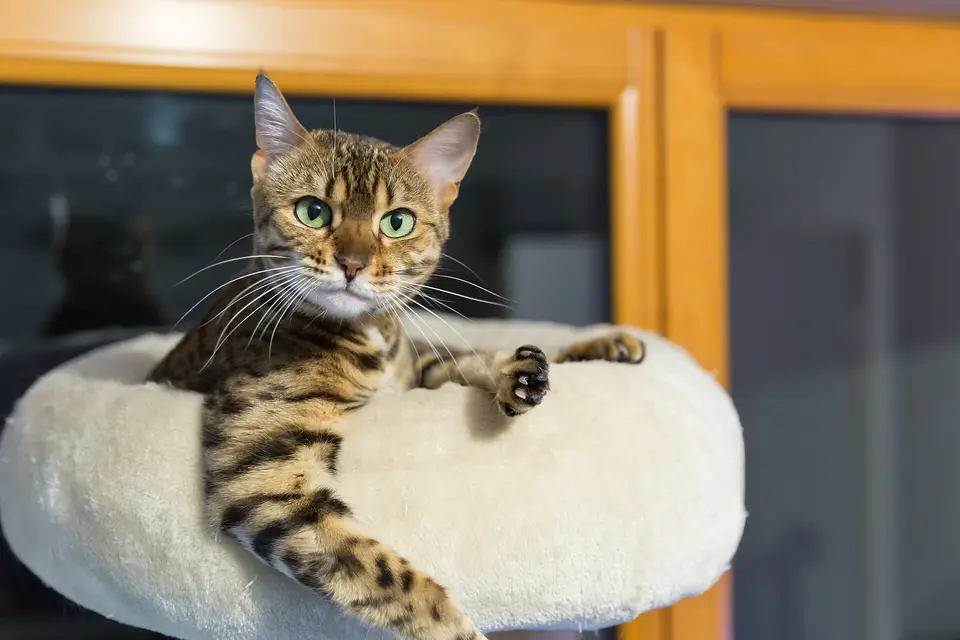
Cats feel safer when they can watch their territory from above. The guidelines note that elevated spots increase a cat's usable space and let it monitor its surroundings. They recommend perches wide and long enough for a full stretch, ideally with a slight hammock-style dip that helps a cat feel tucked in. At least one resting area should give a view of the outdoors.
Practical ways to add height:
- A sturdy cat tree beside a window.
- Wall shelves arranged as a staircase, with secure brackets.
- A window perch rated for your cat's weight.
- Clearing the top of a bookcase and adding a folded blanket.
For kittens and older cats with limited mobility, the guidelines advise keeping perches lower or adding ramps. In multi-cat homes, provide several high spots in different areas so no cat can block another. See how to create a cat-friendly home for more layout ideas.
Idea 4: Safe outdoor time with a catio
A catio is an enclosed outdoor space where your cat can smell, hear and watch the outside world without roaming. Humane World for Animals notes that catios give indoor cats fresh air and new sights, sounds and smells, while also protecting wildlife from free-roaming cats. A catio can be as simple as a window box.
Humane World's safety checklist includes:
- Make it fully escape-proof, with no gaps a cat could squeeze through, including on top.
- Use sturdy, nontoxic materials and attach every part firmly so other animals cannot get in.
- Provide shade, shelter from rain and cold, ventilation and fresh water.
- Build it where you can see it from the house, and supervise your cat while it is out there.
- In areas with coyotes or other large predators, a catio may need to be very sturdy, or may not be suitable.
Harness walking is another option for some cats. The feline guidelines say leash walking can be safe if the cat has been positively trained to a harness and is allowed to choose where to go. VCA recommends introducing the harness gradually with treats and play, and only heading outdoors once your cat is relaxed walking on a leash indoors.
Idea 5: Clicker training
Training is play for the brain, and cats learn well with positive reinforcement. In clicker training, a short, distinct sound marks the exact moment your cat does something you like, and a reward follows. Best Friends Animal Society describes clicker training as a way to give cats an outlet for mental energy and to build confidence in shy cats, and stresses using a reward your cat truly wants and the same sound every time.
A simple way to start:
- Charge the clicker. Click, then immediately give a tiny treat. Repeat several times until your cat perks up at the sound.
- Pick an easy behavior. Touching its nose to your finger or a chopstick (called "targeting") is a common first trick.
- Click the instant it happens, then reward. Timing matters more than anything else.
- Keep sessions very short and stop while your cat is still interested.
Once your cat knows targeting, you can use it to guide them onto a scale, into a carrier or off a counter without any force.
Idea 6: Rotate toys and refresh the environment
Novelty is part of enrichment. The feline guidelines recommend rotating toys to prevent habituation and boredom. A practical system:
- Keep only a few toys out at a time.
- Store the rest in a closed container and swap a few back in every several days.
- Add a cardboard box or paper bag (handles removed) for exploring, then recycle it once it loses its appeal.
Respect your cat's nose, too. The guidelines suggest avoiding strongly scented cleaners and litter, and washing bedding in rotation so some items always smell familiar.
Enrichment at a glance
| Idea | Natural need it meets | Cost | Time per day |
|---|---|---|---|
| Wand toy play | Stalking, chasing, pouncing | Low | Several short sessions |
| Food puzzles and scatter feeding | Foraging, problem solving | Free to low | A few minutes to set up |
| Cat trees, shelves, window perches | Climbing, watching, feeling safe | Low to moderate | One-time setup |
| Catio | Fresh air, new sights and smells | Moderate to high | Supervised time |
| Clicker training | Mental work, confidence | Low | A few minutes |
| Toy rotation | Novelty | Free | A minute every few days |
| Scratchers in several spots | Scratching, scent marking | Low | One-time setup |
Multi-cat homes, kittens and seniors
The feline guidelines add a few adjustments:
- Multiple cats: Keep toys and resources in separate locations to avoid competition, and play with each cat individually at different times and places.
- Kittens: Need more intense and longer play, plus size-appropriate toys and puzzle feeders.
- Older cats: Still need play, but the type and intensity may need to change. Try slower wand movements along the floor.
Scratching is part of enrichment, too. See why cats scratch furniture for how to give your cat good outlets.
The bottom line
Indoor cats thrive when they can hunt, forage, climb, explore and feel safe. Short daily wand-toy sessions that end in a catch and a treat, meals served in puzzles, a perch with a view and a regular toy rotation cover most of what a cat needs. Add a catio, harness walks or clicker training if they suit your cat and your home.
Common questions
How much should I play with my indoor cat?
VCA Animal Hospitals recommends aiming for at least three short play sessions a day, ideally timed around your cat's naturally active periods. Short, frequent sessions suit cats better than one long one.
Do cats get bored with their toys?
Yes. Feline veterinary guidelines recommend rotating toys so cats do not become habituated to them. Put most toys away and swap a few back in every few days.
Are catios safe?
A well-built catio can be a safe way for an indoor cat to enjoy fresh air. Humane World for Animals advises making it fully escape-proof, including the top, adding shade and water, and supervising your cat while it is outside.
Can you really train a cat?
Yes. Cats learn well with positive reinforcement, including clicker training, where a distinct sound marks the moment a cat does something right and is followed by a reward.
Sources
- AAFP and ISFM Feline Environmental Needs Guidelines, American Association of Feline Practitioners and International Society of Feline Medicine (Journal of Feline Medicine and Surgery, 2013)
- Cat Behavior and Training: Enrichment for Indoor Cats, VCA Animal Hospitals
- Catios: Safe Outdoor Enclosures for Cats, Humane World for Animals
- Clicker training for cats, Best Friends Animal Society
- Feline Lower Urinary Tract Disease, Cornell Feline Health Center
- Laser Light Pointers for Use in Companion Cat Play: Association with Guardian-Reported Abnormal Repetitive Behaviors, Animals (Basel), 2021 (Kogan and Grigg)
Written and fact-checked by the Only Hope Cats editorial team against the sources listed above. Read our editorial policy, or tell us about an error.