This is general health information checked against veterinary sources. It isn't a diagnosis or a substitute for advice from a veterinarian who knows your cat. If your cat may be ill or poisoned, call your vet or the ASPCA Animal Poison Control Center at (888) 426-4435 (a fee may apply).
Stress in cats is easy to miss. Cats evolved as solitary hunters for whom any injury was a serious survival risk, so they learned to avoid showing weakness, and many still hide fear, pain and illness well. By the time a stressed cat does something we notice, such as peeing outside the litter box, the stress has often been building for a while. This guide explains the difference between short-term and long-term stress, the signs to watch for, the stress-linked conditions to know about and when to involve your veterinarian.
Why stress matters for cats
The AAFP and ISFM Feline Environmental Needs Guidelines state that a cat's comfort with its surroundings is closely tied to its physical health, emotional wellbeing and behavior. They note that cats often do not show obvious signs of stress, and that studies suggest even calm-looking cats can have raised levels of stress hormones. Several diseases and unwanted behaviors have been associated with stressful environments.
The guidelines also explain that a cat's instinct to hide weakness, pain or illness often delays people from noticing a problem. That is why behavior changes deserve attention. They are frequently the first clue that something is wrong, whether the cause is emotional, medical or both.
Acute versus chronic stress
It helps to think about stress in two ways.
Acute stress is a short-term reaction to something specific: a car ride, a vet visit, a loud noise, a visiting dog or a new cat on the other side of the window. The signs are usually obvious and fade once the trigger is gone.
Chronic stress builds over weeks or months when a cat cannot escape an ongoing problem, such as tension with another cat, too few litter boxes, a chaotic household or a lack of things to do. The signs are quieter and easy to mistake for personality ("she's just shy") or aging. Fear Free Happy Homes notes that ongoing stress can affect a cat's immune system, behavior and overall health, which is why it is worth catching early.
Body language signs of fear and stress
Fear Free describes stress as a spectrum. Cats try to avoid conflict, and when their early signals are ignored, the signals grow louder. Learning the early stages lets you step in sooner.
| Level | What you may see |
|---|---|
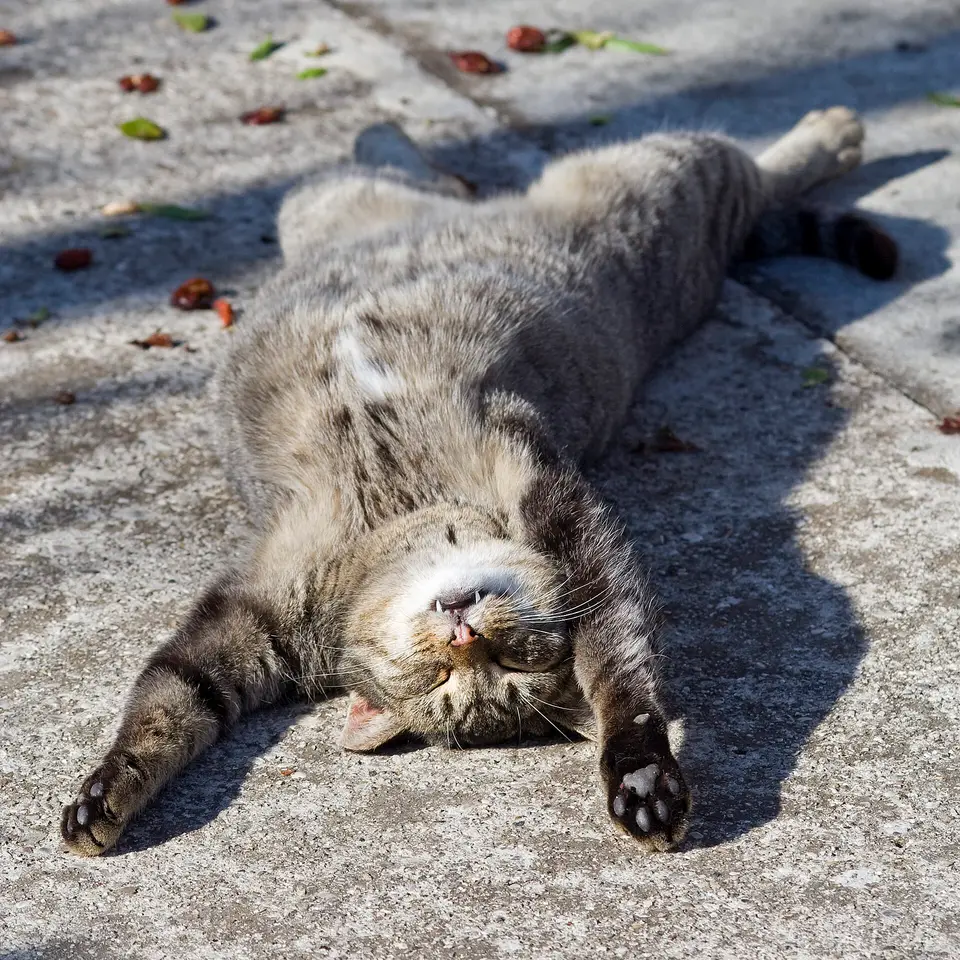
| Relaxed | Loose body, relaxed ears and face, tail up |
| Mild stress | Partly dilated pupils, avoiding eye contact, turning the body away, ears slightly rotated, sudden grooming, tail wrapped close |
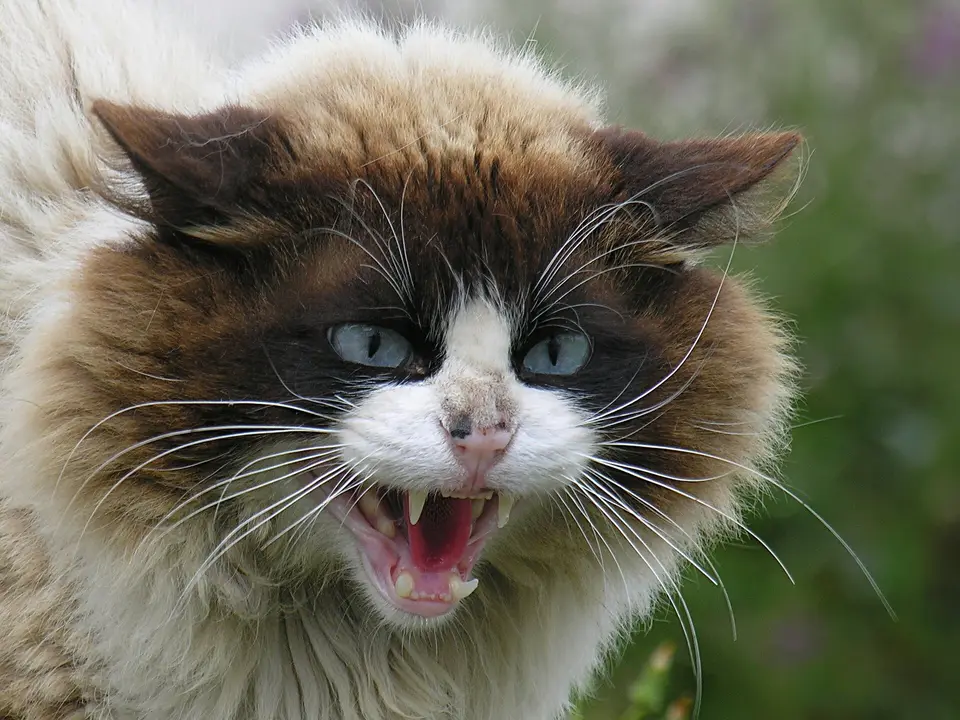
| Moderate stress | More dilated pupils, ears rotated and partly flattened, whiskers pulled back, tense jaw, staring at the threat, possible hissing |
| Severe fear | Trying to flee, ears flat, arched back with bristled tail, or frozen in a tight ball with a fixed stare, hissing or growling |
| Fight | Ears fully flat, whiskers pinned back, tail thrashing, swatting, growling or spitting |
Fear Free also points out that salivating, shaking and a small, crouched posture are often misread. For a fuller walkthrough of the tail, ears, eyes and sounds, see our cat body language guide for families.
Behavior changes that can signal chronic stress
Watch for changes from your cat's normal routine. Any one of these can also have a medical cause, so they are a reason to look closer, not a diagnosis.
- Hiding more than usual. The feline guidelines describe hiding as a coping behavior cats use in stressful situations or to avoid other animals or people.
- Overgrooming. The guidelines list overgrooming among the ways frustration and stress can show up, sometimes leaving thin or bald patches.
- Urinating or defecating outside the litter box, or spraying. The Cornell Feline Health Center explains that stress plays a role mainly in spraying, which cats may do when they sense a threat to their territory or are frustrated, for example by too little playtime. House soiling also has many medical causes.
- New aggression. Hissing, swatting or biting, including redirected aggression toward a person or another pet after seeing something upsetting such as an outdoor cat. Cornell's guide to feline aggression recommends ruling out medical causes such as hyperthyroidism, arthritis or dental disease first.
- Pacing, restlessness or vocal changes. The AAFP's guide to introducing cats lists pacing, growling, hissing, avoidance and changes to normal behavior as stress signs. The ASPCA notes that excessive meowing in older cats can come from medical conditions such as an overactive thyroid or kidney disease.
- Eating and toileting less in new places. The feline guidelines note it is not unusual for cats to skip eating or eliminating for the first 24 hours in an unfamiliar environment such as a veterinary hospital.
Common stress triggers
Cornell lists environmental changes, changes in feeding schedules and changes in the number of animals in the household as stress factors linked to feline idiopathic cystitis. Other common triggers described in veterinary guidance include:
- A new cat, dog or other change in who shares the home.
- Conflict with another cat in the home, especially over litter boxes, food or resting spots.
- Moving house, renovations or rearranged furniture.
- Loud or unfamiliar noises and strong unfamiliar smells, such as perfumes or scented cleaners.
- Seeing unfamiliar cats outside a window.
- Vet visits and car travel.
- Too few resources, or resources placed where one cat can block another.
- Not enough play or chance to "hunt."
Stress-related illness: feline idiopathic cystitis
The best-known stress-linked condition in cats affects the bladder. The Cornell Feline Health Center explains that feline idiopathic cystitis (FIC) is the most common diagnosis in cats with lower urinary tract signs. "Idiopathic" means tests do not find another cause such as stones or infection. Stress appears to be an important factor.
Signs of lower urinary tract disease include:
- Straining or pain while urinating.
- Going more often, often in small amounts.
- Crying out while urinating.
- Blood in the urine.
- Urinating outside the litter box.
- Frequent licking of the genital area.
Cornell notes that signs often resolve within a couple of weeks, but veterinarians usually treat FIC to reduce the chance of it coming back. Enrichment and reducing environmental stress can make episodes less frequent and less severe.
Vet check: A cat that strains in the litter box and produces little or no urine is an emergency. Cornell warns that a blocked urethra, which is more likely in male cats, can lead to life-threatening electrolyte imbalances, and that death can follow a complete blockage in less than 24 to 48 hours. Go to a veterinarian or emergency clinic right away.
When to see your veterinarian
Because stress signs overlap with signs of illness and pain, a veterinary exam is the right first step for most changes. Cornell advises a thorough physical exam and diagnostic tests before treating house soiling as a behavior problem, because cats with medical conditions may not always act sick. Humane World for Animals likewise recommends a vet visit when a cat's behavior changes noticeably.
Vet check: Book an appointment if your cat has any sudden change in litter box habits, appetite, grooming, activity, vocalization or temperament, or if milder signs do not settle quickly once a known trigger is gone. Seek emergency care right away for straining to urinate or any sign that your cat is in obvious pain.
If medical causes are ruled out and stress continues, your veterinarian may refer you to a board-certified veterinary behaviorist.
How to lower your cat's stress
The five "pillars" in the feline environmental guidelines are a useful checklist:
- A safe place. Give every cat at least one private hiding spot, ideally raised, such as a box on its side with a perch on top or a carrier left out with a soft blanket.
- Separate key resources. Food, water, litter boxes, scratchers and resting areas in different locations, with enough for every cat. Cornell's guidance for cats with FIC includes one more litter box than the number of cats, kept clean and in quiet places.
- Play and predatory behavior. Daily interactive play and food puzzles. See our indoor cat enrichment ideas.
- Predictable, positive human contact. Let your cat choose when to interact, and keep routines such as mealtimes consistent.
- Respect for smell. Avoid strong scented cleaners and litters, and wash bedding in rotation so familiar scents remain. The guidelines also mention synthetic feline facial pheromone products as a possible way to reduce anxiety. Ask your veterinarian whether one makes sense for your cat.
A few more practical steps:
- Introduce changes slowly. New pets in particular need a gradual introduction. Our guide to introducing two cats safely walks through each stage.
- Block upsetting views. Cornell suggests window coverings if outdoor cats trigger your cat.
- Never punish. Cornell notes physical punishment can increase fear and anxiety and make aggression worse, and that punishing house soiling does not work.
For parents: Children can help a stressed cat by keeping voices low near its hiding spot, never pulling it out from under furniture and letting it approach on its own terms. Our guide to teaching children to interact safely with cats has more ideas.
The bottom line
Stressed cats tend to withdraw rather than complain, so look for quiet changes: more hiding, overgrooming, litter box problems, new irritability or a cat that avoids eye contact and turns away. Ongoing stress is linked with real illness, especially feline idiopathic cystitis, and straining to urinate is an emergency. Meeting your cat's core needs for safety, separate resources, play and predictable routines prevents much of the problem. This article is general information, and your veterinarian should guide decisions about your individual cat's health and behavior.
Common questions
What are the first signs a cat is stressed?
Early signs are subtle: avoiding eye contact, turning away, slightly dilated pupils, ears rotating sideways, a tail held close to the body and sudden bursts of grooming. More obvious signs include hiding, hissing, flattened ears and a crouched body.
Can stress make a cat sick?
Stress appears to be an important factor in feline idiopathic cystitis, a common cause of painful, frequent or bloody urination. Veterinary guidelines also link stressful environments with other illnesses and unwanted behaviors.
When is a stressed cat an emergency?
A cat, especially a male, that strains in the litter box and passes little or no urine needs a veterinarian immediately. A complete urethral blockage can be fatal in less than 24 to 48 hours.
Should I comfort or punish a stressed cat that hisses?
Neither forcing contact nor punishing helps. Give the cat space and a place to hide, remove the trigger if you can, and talk to your veterinarian if the behavior continues.
Sources
- Feline Lower Urinary Tract Disease, Cornell Feline Health Center
- AAFP and ISFM Feline Environmental Needs Guidelines, American Association of Feline Practitioners and International Society of Feline Medicine (Journal of Feline Medicine and Surgery, 2013)
- Fraidy Cat? How To Recognize Signs Of Feline Fear, Anxiety And Stress, Fear Free Happy Homes
- Feline Behavior Problems: House Soiling, Cornell Feline Health Center
- Feline Behavior Problems: Aggression, Cornell Feline Health Center
- Step-by-Step Guide: How to Introduce a New Cat to Other Cats in Your Home, American Association of Feline Practitioners (now the Feline Veterinary Medical Association), 2024
- Understanding Cat Behavior and Feline Language, Humane World for Animals
- Meowing and Yowling, ASPCA
Written and fact-checked by the Only Hope Cats editorial team against the sources listed above. Read our editorial policy, or tell us about an error.