Cats rarely bite or scratch "out of nowhere." Long before a swat, most cats have already said "please stop" with their tail, ears, eyes and posture. Adults and children who learn to read those signals have fewer scratches, calmer cats and a much better relationship with the animal they share a home with. This guide walks through each part of the body, then turns it into a simple green, yellow and red system that kids can use.
Read the whole cat, not one signal
No single body part tells the full story. A swishing tail can mean a cat is about to pounce on a toy or that it is fed up with being handled. Best Friends Animal Society stresses reading the whole body together with what is happening around the cat. A cat crouched with big pupils in front of a wand toy is playing. The same crouch and pupils while a toddler reaches for it means fear.
Facial signals tend to change first. The AAFP and ISFM Feline Environmental Needs Guidelines note that a cat's ears, eyes and whiskers respond more quickly than its body posture, so watching the face gives you the earliest warning.
The tail
The tail is the easiest signal for children to spot from across the room.
- Held high, sometimes with a small curl at the tip: a friendly, confident greeting. Humane World for Animals describes an upright tail with flat fur as alert, curious or happy.
- Straight up and quivering: excitement. In cats that are not spayed or neutered, it can also come before urine spraying.
- Low, tucked or wrapped tightly around the body: insecurity, anxiety or fear.
- Twitching or flicking: focus during play, or rising annoyance. Context tells you which.
- Thrashing side to side: agitation. The faster it moves, the more upset the cat usually is.
- Puffed up like a bottle brush: a frightened or angry cat trying to look bigger.
The ears
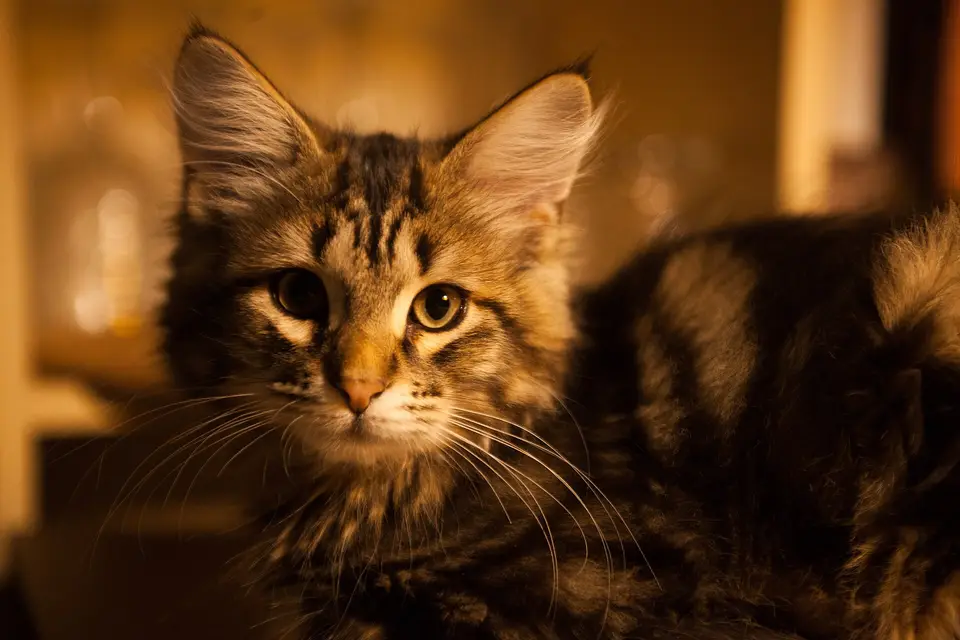
Ears are a cat's mood dial. Relaxed cats hold their ears in a neutral position or tipped slightly forward. Ears pointed forward show interest. Ears that swivel are simply tracking sounds.
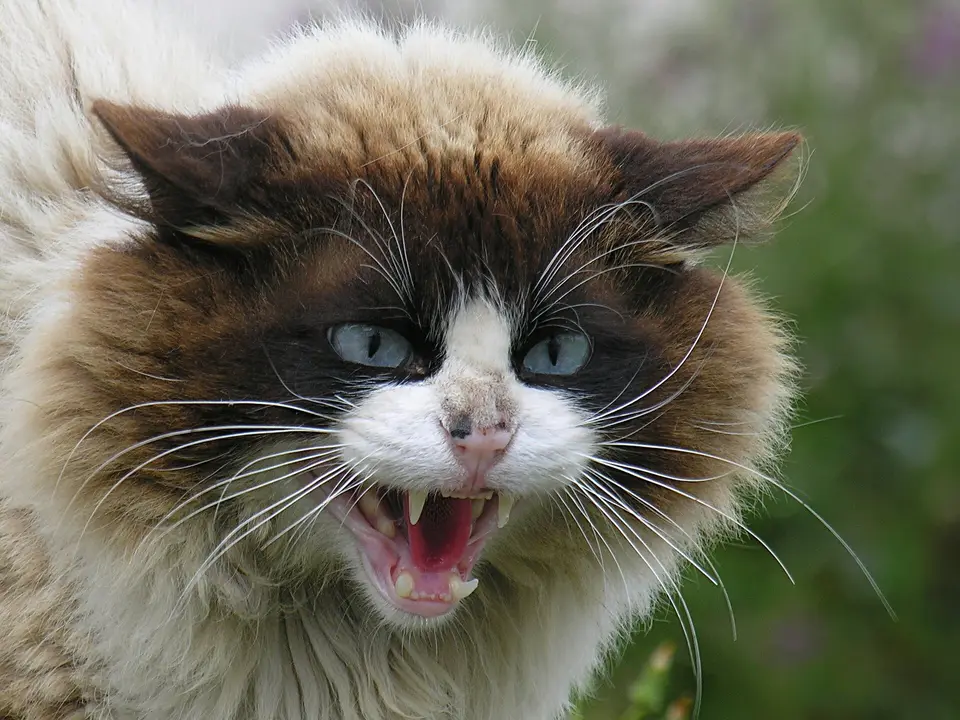
As stress rises, the ears rotate outward or back. When a cat is truly frightened, the ears press flat and low against the head, a position sometimes called "airplane ears." Humane World for Animals links ears pinned back, sideways or flat with irritation, anger or fear.
The eyes and the slow blink
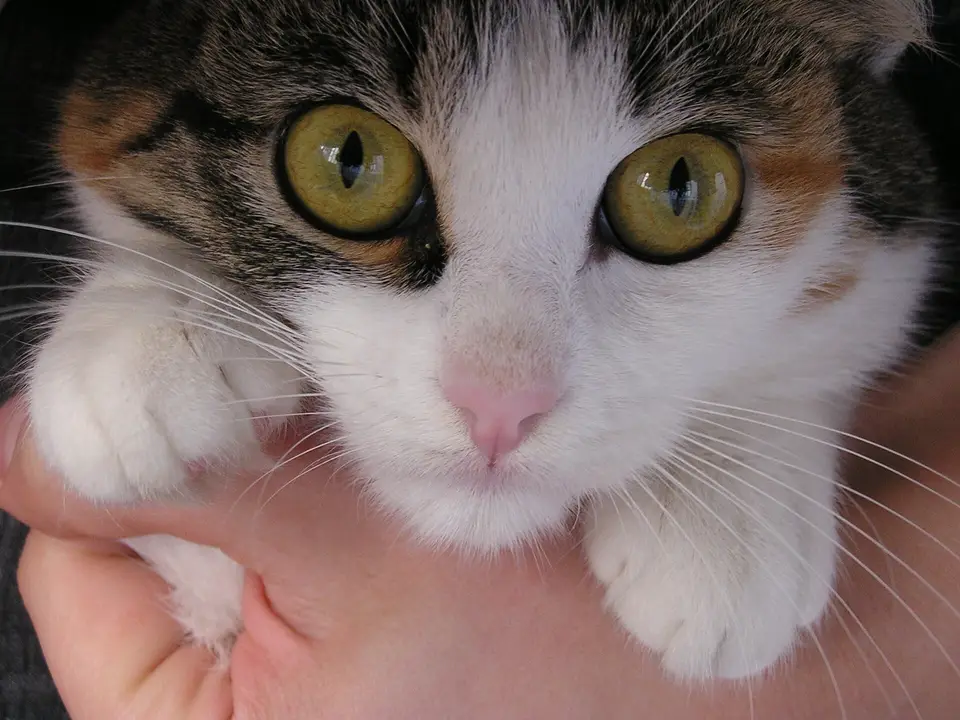
A relaxed cat has medium-sized pupils and soft, slightly droopy eyelids. Playful cats often have wide eyes and dilated pupils. Fearful cats also have large pupils, with either a fixed stare or a squint, so pupils alone cannot tell you whether a cat is excited or scared. Look at the ears and body too. Best Friends also notes that a cat squinting or keeping its eyes closed, especially with the third eyelid visible, may be unwell.
The slow blink is one of the most useful signals for families. In a study reported by the University of Sussex, researchers tested 21 cats from 14 households and found cats were more likely to slow blink at their owners after the owners slow blinked first. In a second experiment, cats were more willing to approach an unfamiliar person's outstretched hand after that person slow blinked at them. The study was small, but it fits with feline veterinary guidance that lists slow blinking as a sign a cat is relaxed and open to interaction.
To try it, narrow your eyes as if giving a relaxed smile, then close them gently for a couple of seconds. It is a good alternative to staring, which cats can find threatening. The feline environmental guidelines advise people to avoid fixed eye contact and let the cat approach in its own time.
The whiskers
Whiskers are subtle, but they help confirm what the rest of the face is saying. Relaxed cats hold their whiskers in a neutral position or slightly forward. Whiskers pushed well forward can mean a cat is focused on play or on something it is assessing. Whiskers pulled tightly back against the face usually go with fear or defensiveness. Best Friends notes that a sick cat's whiskers may droop downward.
Posture and the belly
Body posture tells you how the cat feels about its surroundings overall.
- Loose, stretched out or slouched: relaxed.
- Stiff and low to the ground: stressed.
- Crouched or flattened, tail wrapped close: fearful or defensive.
- Arched back, puffed fur, standing tall on the toes: very frightened or ready to defend itself. This is the classic "Halloween cat."
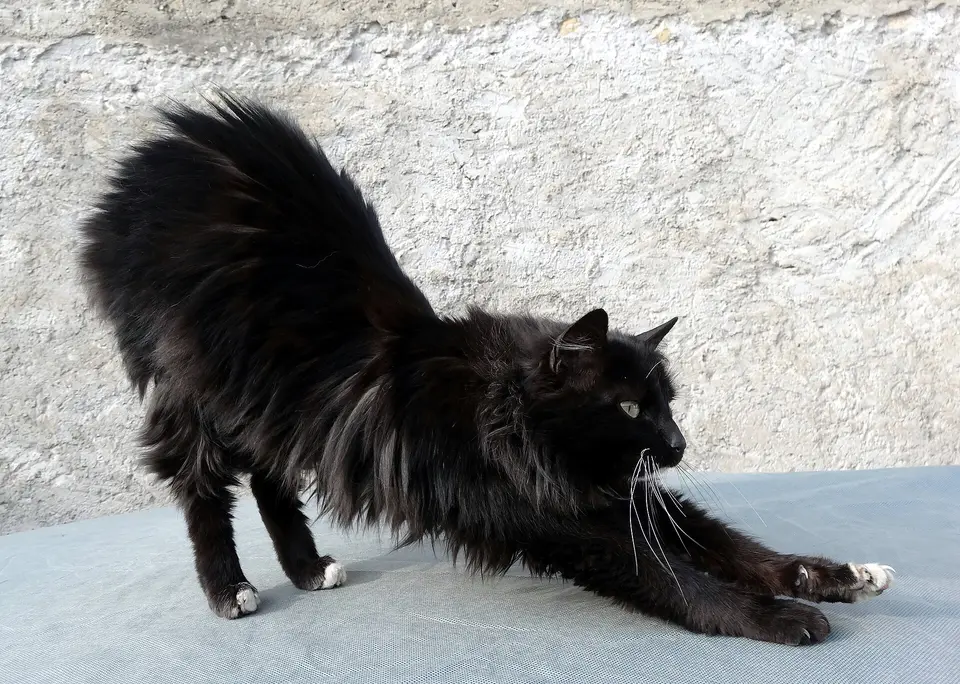
- Arched back with smooth, flat fur, often while rubbing against you: a welcoming stretch that invites gentle touch.
- Curled into a tight ball and withdrawn: possibly unwell, especially if this is new behavior.
The belly causes the most confusion. A relaxed roll onto the side or back means the cat feels safe with you. It is usually not a request for a belly rub. The feline environmental guidelines advise against touching the belly because many cats find that area vulnerable. They also note that most cats prefer petting on the head, cheeks and chin. A cat lying on its back while growling is defensive and may strike.
Myth: A cat showing its belly is asking to be petted there. In reality, it is a sign of trust, and reaching for the belly is one of the most common ways people get scratched.
Sounds
Cats use their voices more with people than with each other. The ASPCA explains that adult cats rarely meow at other cats. Meowing is mostly how they greet people, ask for food or attention, or ask to be let in or out.
| Sound | What it usually means |
|---|---|
| Meow | A greeting, request or complaint aimed at people |
| Chirp or trill | A friendly "follow me," often toward the food bowl |
| Purr | Usually contentment, but cats also purr to soothe themselves when anxious, sick or in pain |
| Chattering | Excitement, often while watching birds or squirrels through a window |
| Hiss, growl or spit | Fear, annoyance or anger. Give the cat space right away |
| Yowl or howl | Distress, pain or mating behavior in unaltered cats. Older cats may howl when disoriented |
If an older cat suddenly becomes much more vocal, the ASPCA recommends a veterinary visit, because conditions such as an overactive thyroid, kidney disease or cognitive decline can cause it.
The green, yellow, red system for kids
Children do not need to memorize every signal. A traffic-light system turns all of the above into three simple choices. Teach it with pictures or by watching the family cat together.
| Zone | What you see | What it means | What to do |
|---|---|---|---|
| Green | Tail up, ears forward or neutral, soft eyes or slow blinks, loose body, head bunting, purring with relaxed body | "I'm comfortable." | Hold out a hand at the cat's level and let it sniff first. Pet the cheeks, chin or head gently if the cat leans in |
| Yellow | Tail twitching or wrapped close, ears turning sideways, pupils getting bigger, cat looks away or turns its body away, starts grooming suddenly | "I'm not sure about this." | Stop petting. Sit still and let the cat choose to stay or leave |
| Red | Ears flat, pupils very large, tail thrashing or puffed, crouched or arched, hissing, growling, swatting | "Back off now." | Move away calmly without grabbing or chasing. Tell an adult |
The yellow zone matters most. Fear Free Happy Homes describes how cats first try to avoid conflict with small signals such as looking away, turning the body aside or wrapping the tail closer. When those early signals are ignored, the cat's posture and voice escalate. Teaching children to stop at yellow prevents most red-zone moments.
For parents: Young children often miss early warning signs. The Cornell Feline Health Center specifically advises supervising young children with cats because they tend to overlook cues such as dilated pupils, a lashing tail and ears pulled back. Never leave infants or toddlers alone with a cat.
Teaching children to respond kindly
Knowing the signals is only half of it. Children also need a few simple habits:
- Let the cat come to you. Sit or crouch at the cat's level, hold out a relaxed hand and wait. The feline environmental guidelines recommend letting the cat start, choose and end any contact.
- Pet where cats like it. Cheeks, chin and the top of the head are usually welcome. Skip the belly, tail and paws.
- Keep it short. Many cats prefer frequent, brief, gentle contact over long cuddles. A few strokes, then a pause, lets the cat say whether it wants more.
- Respect the walk-away. When a cat leaves, the conversation is over. Do not follow, pick it up or pull it back.
- Leave sleeping and eating cats alone. The American Academy of Pediatrics, via HealthyChildren.org, advises keeping young children away from pets while they eat or sleep and keeping faces away from an animal's face.
These habits are covered in more depth in our guide to teaching children to interact safely with cats, and our printable cat body language guide is a handy reference to stick on the fridge. For ways to channel a child's energy into play the cat enjoys, see safe games children can play with cats.
When body language changes suddenly
A cat whose signals shift over days or weeks, such as one that starts hiding, hissing at familiar people or sitting hunched, may be stressed or in pain rather than "grumpy." Cats are good at hiding discomfort, and behavior changes are often the first clue.
Vet check: If your cat's usual body language changes without an obvious reason, especially with hiding, a hunched posture, squinting or changes in eating or litter box habits, schedule a veterinary exam. Read more in how to recognize signs of stress in cats.
The bottom line
Cats communicate constantly through their tail, ears, eyes, whiskers, posture and voice, and they almost always warn before they swat. Read the whole cat, pay special attention to the face, and treat yellow-zone signals as a cue to pause. When everyone in the family learns to stop at yellow, cats feel safer and children get to enjoy the friendly green-zone moments far more often.
Common questions
Does a cat lying on its back want a belly rub?
Usually not. A relaxed roll that shows the belly is a sign the cat feels safe, but feline veterinary guidelines advise against touching the belly because many cats find it a vulnerable spot. Offer a gentle chin or cheek scratch instead.
What does it mean when a cat slow blinks at you?
A slow blink is generally a relaxed, friendly signal. In a University of Sussex study, cats were more likely to slow blink back at people who slow blinked at them, and more likely to approach a stranger who had done so.
Does purring always mean a cat is happy?
Not always. Purring usually signals contentment, but cats can also purr to soothe themselves when they are anxious, sick or in pain, so read it alongside the rest of the body.
Why does my cat's tail twitch when I pet her?
A twitching or lashing tail during petting often means the cat is getting overstimulated or annoyed. Stop petting and let her walk away before she escalates to a swat or bite.
Sources
- Understanding Cat Behavior and Feline Language, Humane World for Animals
- How to Read Cat Body Language and Emotions, Best Friends Animal Society
- AAFP and ISFM Feline Environmental Needs Guidelines, American Association of Feline Practitioners and International Society of Feline Medicine (Journal of Feline Medicine and Surgery, 2013)
- Feline friendly? How to build rap-paw with your cat – new psychology study, University of Sussex
- Fraidy Cat? How To Recognize Signs Of Feline Fear, Anxiety And Stress, Fear Free Happy Homes
- Feline Behavior Problems: Aggression, Cornell Feline Health Center
- Meowing and Yowling, ASPCA
- How old should our children be before we adopt a pet?, HealthyChildren.org (American Academy of Pediatrics)
Written and fact-checked by the Only Hope Cats editorial team against the sources listed above. Read our editorial policy, or tell us about an error.